Commercial Water Deionization
and DI Water Systems in Michigan
When dissolved minerals and salts can affect product quality, sensitive equipment, or test results, ordinary filtration may not be enough. Besco Commercial designs, installs, and supports DI water systems that deliver the purity, flow, and capacity required by each facility.
We provide commercial water deionization in Michigan for laboratories, pharmaceutical operations, manufacturers, EDM shops, electronics facilities, metal finishers, power plants, and other demanding applications. Our team begins by testing the source water and reviewing the process requirements before recommending a treatment and supply strategy.
Besco operates Michigan’s largest DI regeneration plant and one of the Midwest’s largest high-purity water treatment operations. This experience makes us the strongest choice for all of your Michigan DI water needs from a single point of contact. For help with any of your DI water treatment needs, call us or contact us.
How a Commercial Deionized Water Filtration System Works
A commercial deionized water filtration system is more accurately described as an ion-exchange system. Instead of simply trapping particles, DI resin removes electrically charged contaminants dissolved in the water.
Cation resin exchanges positively charged ions, such as calcium, magnesium, sodium, and dissolved metals, for hydrogen ions. Anion resin exchanges negatively charged ions, including chloride, sulfate, nitrate, and bicarbonate, for hydroxide ions. The hydrogen and hydroxide combine to form purified water with very low conductivity and high resistivity.
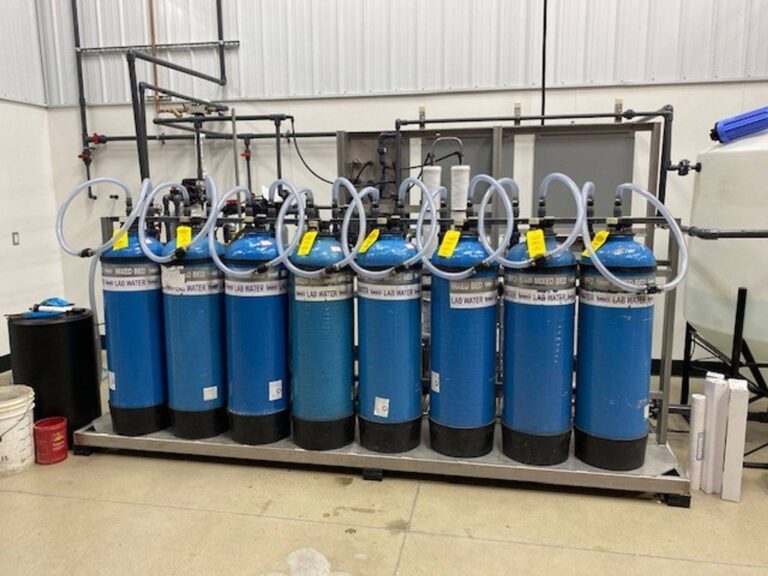
Besco can configure mixed-bed or dual-bed DI systems based on the required water quality and application. Depending on the source water and purity target, the system may also include reverse osmosis, carbon treatment, UV, or final filtration. Deionization removes dissolved ions effectively, but it does not remove every particle, organic compound, or microorganism by itself.
Commercial DI Water Solutions and Support
Facilities do not all need to produce or receive DI water in the same way. Besco considers source-water chemistry, required purity, peak flow, operating hours, available space, storage, existing infrastructure, and the consequences of an interrupted supply.
Onsite Commercial DI Systems
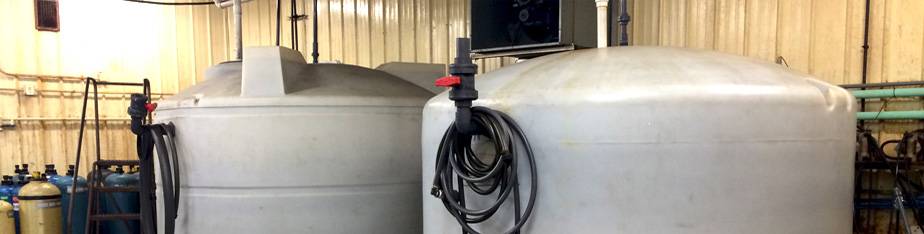
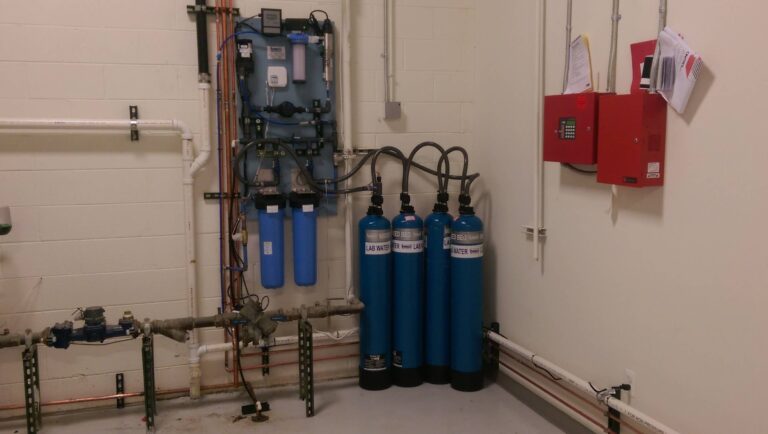
An onsite DI system can support facilities with steady or high-volume demand. Besco sizes each system around the required output and can integrate it with existing pretreatment, storage, distribution, controls, and monitoring equipment.
Our team supports the complete system from initial testing and engineering through installation, startup, maintenance, and repair.
Portable DI Tank Exchange Service
Portable exchange tanks provide deionized water without requiring your employees to regenerate resin onsite. Besco supplies charged tanks and replaces them with regenerated tanks when the resin approaches exhaustion.
Our DI tank exchange service can support laboratories, manufacturers, healthcare facilities, and other operations with variable demand or limited space. Exchange schedules are based on feed-water quality, water usage, and the facility’s purity requirements.
Bulk DI Water Delivery
Some facilities need large quantities of DI water without installing permanent generation equipment. Others need supplemental capacity during a startup, production increase, maintenance shutdown, or unexpected system failure.
Besco offers bulk DI water delivery for one-time and recurring needs. Delivery can serve as a facility’s primary water source, supplement an onsite system, or provide backup capacity.
DI Water System Service, Maintenance, and Repair
Besco provides DI water system service for our own equipment and systems installed by other manufacturers. Our technicians can test output quality, inspect tanks and valves, verify pressure and flow, troubleshoot controls, assess pretreatment, and identify declining resin performance.
DI water service should be based on actual operating conditions rather than a generic replacement interval. Source-water chemistry, usage, resin capacity, and the required conductivity or resistivity all affect how frequently a system needs attention.
Besco can establish a preventive maintenance and monitoring plan that identifies declining performance before water falls outside specification. We also provide 24/7 emergency support when a system problem threatens production or facility operations.
DI Water Applications for Michigan Facilities
Besco provides deionized water for industrial use and laboratory applications throughout Michigan. The appropriate system and purity level depend on how the water interacts with the process, equipment, or finished product.
-
Deionized Lab Water in Michigan
Michigan laboratories may use DI water for glassware rinsing, reagent preparation, instrument feed, sample processing, and other controlled applications. The required water quality depends on the testing method, equipment specifications, and laboratory protocol.
DI treatment alone does not automatically produce Type I or ultrapure laboratory water. More demanding applications may require reverse osmosis, UV treatment, final polishing, or continuous water-quality monitoring.
-
Pharmaceutical and Life-Science Applications
Pharmaceutical and life-science facilities may use DI as one stage within a larger water treatment process. Besco designs pharmaceutical water treatment systems around the source water, production equipment, process requirements, and facility quality controls.
The treatment stages and monitoring requirements must match the intended use. Besco works with facility teams to produce water that meets the specifications established for their equipment and processes.
-
Manufacturing, Rinsing, and Metal Finishing
Manufacturers use DI water for parts washing, final rinsing, plating, coating preparation, chemical blending, and equipment feed. Reducing dissolved minerals can help limit spotting, deposits, and residue while supporting more consistent results.
A final rinse may have different purity and flow requirements than a production line, plating operation, or recirculating process-water loop. Besco evaluates the complete application before recommending a system.
-
Deionized Water for EDM
Wire electrical discharge machining uses controlled-conductivity water as a dielectric fluid. Proper water quality helps maintain stable cutting conditions and protect the workpiece and equipment.
Besco provides treatment and support for facilities that need deionized water for electrical discharge machining, including system design, tank exchange, monitoring, and ongoing service.
DI water may also support electronics manufacturing, aerospace production, data center humidification, power generation, cosmetics manufacturing, and other processes with strict water-quality requirements.
Why Michigan Facilities Choose Besco for Commercial Water Deionization
As the operator of Michigan’s largest DI regeneration plant and one of the Midwest’s largest high-purity water treatment operations, we are your single experienced provider for all your DI water treatment needs.
From initial testing and system design through installation, scheduled maintenance, troubleshooting, and emergency support, Besco helps facilities maintain consistent water quality while reducing avoidable interruptions.
Besco has served commercial and industrial water users since 1961. Our WQA-certified technicians bring more than 300 years of combined experience to complex water treatment applications.
Commercial Deionized Water FAQ
-
What industries use deionized water?
DI water is commonly used by laboratories, pharmaceutical companies, electronics manufacturers, metal finishers, EDM shops, automotive and aerospace manufacturers, power plants, data centers, and cosmetics producers. The required purity depends on how the water interacts with the process, equipment, or finished product.
-
How is deionization different from reverse osmosis?
Reverse osmosis forces water through a membrane to reduce a broad range of dissolved contaminants and other impurities. Deionization uses ion-exchange resin to target electrically charged minerals and salts.
RO and DI are often used together. RO can reduce the contaminant load before the water reaches the DI resin, while DI provides final polishing for applications requiring lower conductivity.
-
Does a commercial DI system require maintenance?
Yes. Conductivity or resistivity should be monitored to confirm that the system continues to meet its target. Tanks, valves, controls, pretreatment equipment, pressure, and flow should also be inspected regularly.
Service frequency depends on water chemistry, usage, resin capacity, and required purity rather than a universal replacement schedule.
-
Can deionized water be used for drinking?
Deionization does not automatically make water safe to drink. DI resin removes dissolved ions, but the process alone may not remove microorganisms, particles, or every nonionic organic contaminant.
Water intended for consumption must come from a complete treatment and distribution system designed and tested to meet applicable drinking-water requirements. Commercial DI systems are generally designed for industrial, laboratory, or process applications.
-
How do I know when my DI tanks need to be exchanged?
An increase in conductivity or decrease in resistivity indicates that the resin is approaching exhaustion. A monitoring system may also provide an alarm when the water nears its established quality limit.
Besco can determine an exchange point based on the facility’s purity requirements, feed-water chemistry, and typical throughput. Tanks should be exchanged before contaminant breakthrough affects the process.
-
Is DI water safe for the plumbing in my Michigan facility?
DI water can be distributed safely when the plumbing system is designed for the required purity. Because high-purity water readily picks up ions, incompatible piping, tanks, pumps, or seals may cause corrosion or recontaminate the water.
Besco reviews the distribution materials, storage equipment, system components, and target water quality before recommending a solution.
Plan a Reliable DI Water Supply
Choosing a DI solution requires more than estimating daily water consumption. Besco will review your source-water chemistry, purity target, flow, peak demand, operating schedule, distribution system, available space, redundancy needs, and downtime risks.
We can then compare on-site generation, portable tank exchange, bulk delivery, or a combined approach and explain the operational advantages of each option.
Contact Besco Commercial to schedule a water analysis and discuss commercial water deionization service in Michigan.